Overview
Population and Size
On average usually between 60 and 80 students start attending the academy every year. Classes for the average student take 4 years to complete. About half of the student body will remain as a Graduated Practitioner and perform research for at least 3 more years. This places the average student count on campus to be around 400 students give or take. There are about 40 or so faculty of educators, about the same in other staff positions. Not to mention the variety of individuals who visit or temporarily use the academy as grounds for arcane collaboration. The academy is capable of having nearing a thousand students if it needs.
Culture
The general culture of the campus and academy is a welcoming one. While rivalries and strong belief in certain arcana being better can occur; generally students are just happy to be in attendance. That said many students in attendance remain in study or similar to study positions in the plane over. In the last several centuries especially the academy is viewed as a great place of study, not of practicum.
Uniform
The uniform of Runagis Academy has changed several times over the years. However, it has been fairly consistent in its design for the last 750 years. It is required to be worn by all students during their time of study and class. There are allowed adjustments and unique aspects for each of the different areas of study. Additionally there are provided alterations for students with unique anatomy, and additions given for cold weather. As long as students are presentable, wearing their required pieces, and chapter cloaks it is uncommon for students to be given criticism or punishment from faculty in regards to uniform appearance.
Base Uniform
The base uniform is primarily a light slate, tans, and saturated charcoal. The moss green color of the academy itself is given to graduated practitioners and faculty who have different uniforms and colors. Most accents and other colorings comes from the chapter cloaks and personal adornments. Very little metal is found on the uniform outside of the colors upon the chapter cloaks.
The uniform has several layers of clothing. The description of the uniform itself will start from base layers to outer layers. At the end shall be descriptions of the chapter cloaks and cold weather additions.
Base Layer
The base layer of the uniform consists of a basic long sleeve tan tunic, which arms on non-specialized uniforms are a little loose and cuffed with charcoal and tan ties. Placed over the tunic before putting on the pants, is a tan and charcoal corded waist cinch, secured just above the hips and lower back to prevent the tunic from catching on the overlayers and any belt packs. The pants are saturated charcoal and thick but breathable fabric, that have loose fitting thighs before tightening below the knee. This allows them to tuck into boots, be tied off into socks, or rolled up and into the wide pleated pants in the heat. Additionally the pants are secured not by a typical button, belt, or clasp. Rather the sides of the pant rise up and twist around the leather waist cord and loop in. This allows individuals with tails to not need specialized pants and can be comfortably adjusted to nearly all Mortals. Charcoal boots with light slate accents are standard, though short dress shoes are also added. Intricate woolen socks of various length and color are included.
Vest and Bag Layer
The next layer over the base is a light slate with inlay vestment. The vest has a cross breast covering by standard fit, pinning and latching around the opposite side of the torso. It can be folded and tucked in such a way for those who wish a lower collar opening. Above the cross section is a flat collar opening for the tunic to push through and a slight collar on the vestment. The vest pulls close to the neck to allow shoulders to move and has hook points for chapter cloaks. On the front of the vestment it ends just above the corded cinch and leaves room for belt and bags. The back and side of the vestment extends further down to the mid thigh. Allowing to cover some waist additions as well as create a flow to the silhouette. Students are given a variety of standard shoulder bags, small component pouches, book straps and other additions that work with the vestment and cinch wrap that would be applied at this layer. Some students may also linen skirt of slate color with tan and charcoal trims.
Outer Layer
The outer layer consists of a few different pieces of neckwear that is optional for students who wish to bind their tunic collar and vestment in various fashions. Additionally those with other armors would apply them at this time.
Chapter Cloaks
The chapter cloaks are all identical in their construction but feature their chapter colors and symbology in different ways. They are the most important piece of the uniform and rarely are students seen without them. They server multiple purposes and do allow for the ability to be worn over armor and do not impede on the modifications to uniforms that are provided by each school of curriculum. The cloaks are saturated charcoal in color by default and woven of a breathable wool. They all have hoods that by default are pinned and clasped to short hoods, but for students who wish to wear hats it can be undone to long points. The cloak attaches to the vestments and armor up above the shoulders and on the collar. This allows the cloak to be pushed back, though most wear it covering their arms. Part of the purpose and design of the cloak is to allow magic practitioners to hide their somatic components during casting. Near the location of clasping the cloak is split. Here armored shoulders can fit through. The front portion of the cloak has a long strand on each side that frames the torso and waist of the wearer. Settling to small pointed strands nearing the mid thigh. These sections can be used to tie around the neck as well during points of travel, as well as be tied together to form a front smock on craftsmen. These possess inlay and metal trim of the given chapter. Same with the trim of the main cloak, which features pleated lines of metal additions to protect and highlight each given chapter. While the back of the cloak does not have the symbols of the chapters, the inside of the cloak contains a soft silk pattern of each mascot beast. This colorful and slick design provides a stark contrast to the rest of the uniform. Additionally the cloak cannot be destroyed by mundane means and self cleans itself.
Cold Weather Additions
Each student is provided a few standard additions for cold weather. Some students may elect to wear them year round or not at all. Minor adjustments to the base uniforms beyond this are of course allowed, but most stick with these.
- Longer Vestment - A secondary vestment that has longer trails that gather closer in the front as well. While resulting in harder access of the waist cinch and other waist options, it is made of a thicker wool and can be used to keep warm. Some students enjoy the appearance and have less need of bags and belt access so they wear this year round.
- Fur Cloak Addition - A trim addition of thick fur harvested from the local Staustags. Dark brown in color but can be dyed. Does not possess the same enchantment as the cloak itself.
- Boot Covers - Thick water resistant burlap cloth boot covers that attach to the knee sections of the base layer. To go over the boots and attach to the ankles. Gives an added layer of defense against wind and weather.
Curriculum Unique Changes
- Abjuration: Short base sleeves on the tunic with metal cuffs that can adjust the length. Allows for easier freedom of movement, can work with other armor additions and various other defensive needs.
- Conjuration: A glove for the non-dominant hand that contains enchantments to provide compass, time, star map, and planar information. Assisting students from ever being lost. Additionally have small circular patterns to help with runes.
- Divination: High collars with additional connections on the vestment. Can be pulled further up and out. When in combination with the standard cloaks hood creates a protective space to block out the outside both to focus on divination responses or shield the mind from prying.
- Enchantment: Forearm bracers with inlays and additional guard section that assists students with alternative foci in managing casting arcane methods. Also possesses small language reminders for sounds and commands for all manner of mortals and creatures.
- Evocation: A dominant arm single shoulder guard. Made of metal that extends up from the shoulder with an arched section that slides in the break of the chapter cloak. Provides defense during evocation duals as well as measurement grids for quick and precise aiming and somatic movement.
- Illusion: Long extended sleeves on the tunic with trails that extend downwards towards the ankle when held at the side. Help hide subtle movements for illusion magics and can also be used to pull up quickly to block blinding lights or be waved into darkness and illusions.
- Necromancy: Knee high boots that are air and water tight. Heavy top coverings with gentle enchantments on the soles. Allows for ease in wading through decay, flora, or able to brace to assist in gathering injured out of harms way.
- Transmutation: A waist and lower back extra satchel spaces. Meant to not hinder movement but provide quick access to various components and other materials. Also can be used to house salves and supplies for those impacting their own body.**
History
Founding - 1183
Founded over two millennia ago, Runagis Academy was an idea built by Somagis, an ancient practitioner of various arcane arts. After spending many centuries of his youth dealing with Giants and Dragons having grand efforts being toppled in the area, he decided to pass down his education and research alongside others and built the academy. It was a slow start, but his and other faculties exploits brought many interested parties and plenty of funds to build the campus.
Notoriety - 1470
After several centuries of students, Runagis Academy became an elite academy with students and presence all over Lendahnna. At a time when much of the arcane world was in turmoil due to Andurl’s expansion, and conflict in Renmorelli’s Hold. Some arcane history would consider this the golden period of Runagis Academy. Though this near millennia of operation led to both incredible arcane discoveries but also conflicts and issues with practices.
Death of Founder - 2240
Somagis’ long life came to an end in 2240 which resulted in the first naming of a Headmagus. Some policies also were put into flux during this time. Due to many of the issues and dangers of the academy resulted in tightening of rules and safety of study at the academy.
Settling - 2415
Much of the current procedure fell into place around this time. Additionally other arcane academies started to prosper and open all over Lendahnna. Which means that the remote location of Runagis Academy resulted in less number of students. Sure, some still went out of their way, but now major academies existed in all the powerful nations that still stand today.
Time of Old Guard - 2700
This is the time in which the current Headmagus Astren Ikkal attended the Academy. Some other older elven professors and staff also attended around this time. There are no individuals on campus that have been around longer than this time.
Current - 3205
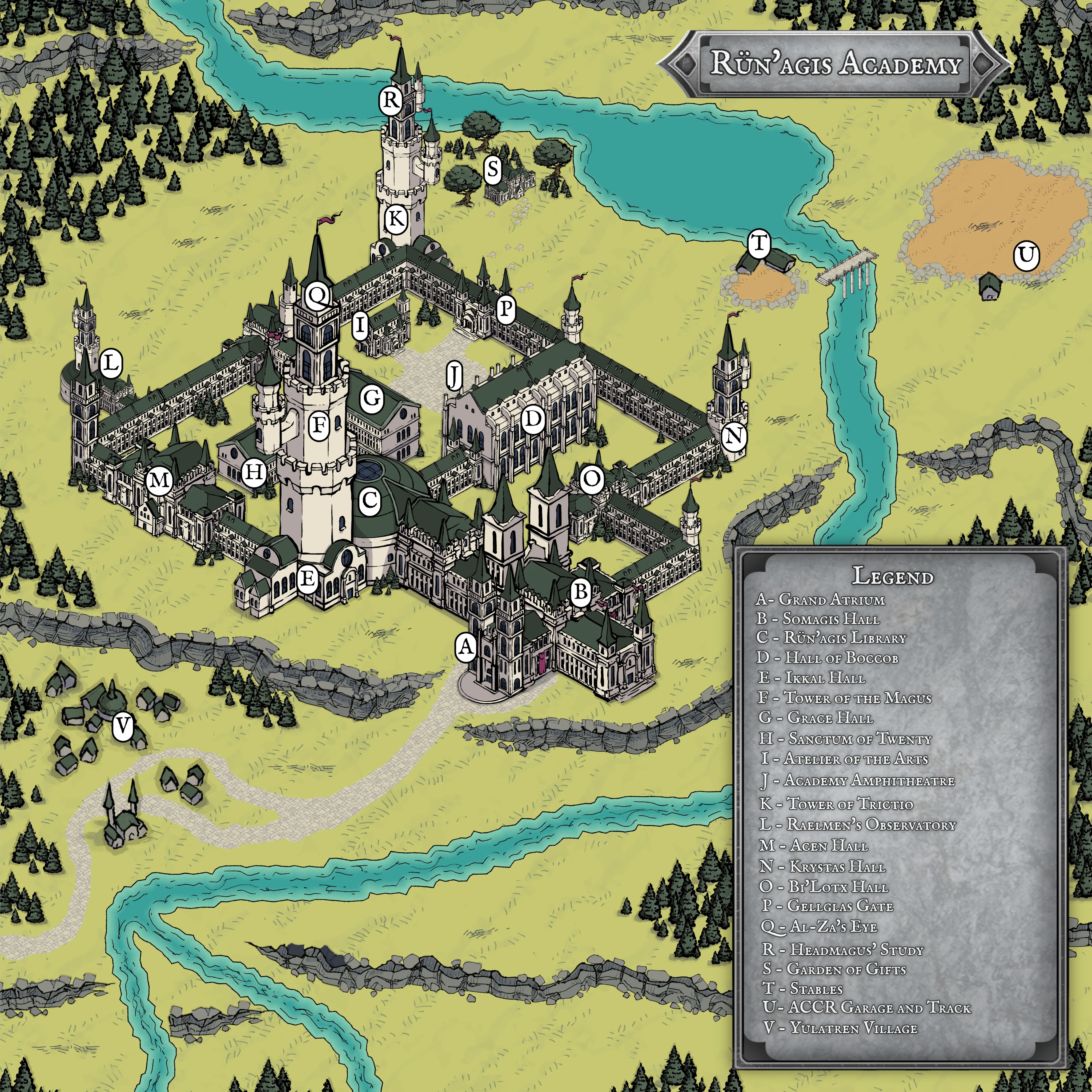
Academy Grounds and Locations
Halls
Many of the Halls on Runagis Academy grounds are named after founders or old faculty from the academy there is no hall on campus that is newer than a couple of centuries, and most were constructed at the time of founding in 1183.
Grand Atrium
A grand display of arcana and magic. Wide open spaces open up into Runagis Academy. Heavily warded with some attendants and students to assist with outsiders but regularly closed to the outside world during class being in session. Hosts the majority of Arcanon during the Spring to highlight students study and work. Old architecture that blends pristinely preserved merging between ancient Elven artisan design and purposeful structured work of early Mortals. Many glass windows and arcane light sources.
Somagis Hall
The largest hall at Runagis Academy. The upper floors are filled with both offices and quarters for most of the staff and the offices of the Masters and logistical operations of the academy. The lower floors and many open classrooms that spread in all directions after stepping through the Grand Atrium are home to most of the introductory general classes that all students must take, as well as many of the courses that have less to do with the arcane. Somagis Hall carries the architecture and design of the Atrium and is just as old. Many of the classrooms are laid out to be of use to the form of study and possesses more mundane applications of arcana to keep students grounded in basics.
Chapter of the Cobalt Crescent On the upper floors bordering the Library within Somagis Hall is the dorms and living areas of the Chapter of the Cobalt Crescent. The common space is physical and tangible. Filled with cared for wooden interiors and bookshelves. Cushioned nooks with windows to the grounds of the academy. The dorms and individual rooms are in pocket planes of stretched space. Most rooms are small and for singular individuals, especially those who remain for research. However there are a few group rooms for those who wish to bunk with friends and Chapter-mates.
Rün’agis Library
The central jewel of Runagis Academy. The library is a grand circular space of thousands of books several stories in height. The roof of which has multiple layers of enchanted glass work. Pillars of bookshelves rise up from the floor and shift around. Platforms for study space float and rotate through the open space. While some areas of the library are only allowed for Graduated Scholars, Elite Guests, and Faculty, the average student would be hard pressed to not find some book, scroll, or research of some interest or need. Tended to by several librarians, students, The Kaloni Phansyn, Master of Books and many cute lantern dragonettes to assist with lighting and company.
Hall of Boccob
The second largest hall at Runagis Academy. Home to most of the classes within Abjuration, Conjuration, Evocation, Illusion, and Transmutation. While some of the crafting aspects to those curriculums may be elsewhere the central classrooms, faculty offices, and research quarters reside here in the Hall named for the God of Magic. The upper floors is home to the research and faculty offices. The lower levels house both small intimate classrooms for study as well as enchanted for safety open spaces for certain study. Additionally most of the arcane dueling on campus occurs in this hall.
Ikkal Hall
A small hall housed at the base of the Tower of The Magus. Slightly newer in architecture and design than the Library and other halls thus far; though still very old by most people’s ideas. Filled with many small rooms each with unique design. Lots of these rooms are utilized by various clubs and study groups. Though confusing non-linear halls can lead sleep deprived students to have a headache getting out of the hall.
Chapter of the Celestial Sun While hard to know if it is in the tower or the hall. The Chapter of the Celestial Sun is located in Ikkal hall on the upper levels. Their dorms and commons are a singular connected space. A central cylindrical chamber of which the ground level of is filled with wide tables, warm colors, and illustrious design. Rising the sides of the room are stairs and doors that lead into the rooms of students. Most rooms house at least two students, some exception to Graduated Practitioners; though first years are required to be placed into group rooms between four to six students. This fosters the political mentality of the Celestial Sun.
Grace Hall
Grace Hall is a central location on campus and also one of the newest buildings. It stretches into the outer corridors to where it is still some of the older architecture but the central building that reaches into the central yard of Runagis Academy is a ‘newer’ building. Renovated and constructed about 200 years ago makes its design much more open in concept, spacious, and using slicker slabs of marble and material. It’s main floor and space is home to the cafeteria on campus. The upper levels are home to a few expansive studios for some performing arts. Additionally Grace Hall is home to acquisitions and material providers for the Academy. Inks, paper and more can be acquired. In the older portion of the hall is a very cozy cafe ran mostly by students. Additionally lots of events are centered in Grace Hall.
Chapter of the Adamantine Dawn In the basement of the older portions of Grace Hall is a cozy and impressive area for the Chapter of the Adamantine Dawn. The common space is home to many couches, tables, and more ‘homely’ aesthetics. Branching from the space are several specialized communal tinkering spaces and artisan locations. Though their capabilities are far less than those in the Atelier or elsewhere on campus. Rooms are added using small pocket planes and are closer to apartments. Each having their own miniature common space with single rooms off of them. Usually sharing between three to eight students in a bunch.
Sanctum of Twenty
The Sanctum of Twenty sticks out on Runagis Academy’s grounds. It is designed in a mix of metal, bricks, and formation that places it as a mishmash of eras and beliefs. Inside is a unilateral chapel space to each of the Gods. However, rather than Twenty locations for worship at the moment. For the last 50 years there are only Eighteen. The Academy recognizes the loss of two deities and as of the last 5 have been stuck in votes from the Deans, Masters, and outside influences if they should be replaced with what Lendahnna has come to assume have taken their place. Most students don’t use the Sanctum nor do they care. A few of the faculty who have studies dealing with The Lower Planes advise that it would be better to construct the places of worship than ignore them.
Atelier of The Arts
A smaller building in comparison to the rest of the campus but an important one none the less. While classes on artificing and other arts do not take place here. Clubs, workshops, and various other space is held here in the delightful semi-outdoor workspace. Any and all forms of craftsmanship and performing arts are practiced here.
Acen Hall
This hall houses larger classroom spaces and intricate research space on the upper floors for Graduated Practitioners. Few standard students will have large amount of courses here but they may occur from time to time. Additionally lots of Arcane History and Preservation is held here. Almost like a partial museum both of The Arcane Plane and the academy itself.
Chapter of the Mithral Moon The only Chapter that has its commons and rooms on the ground level within the Runagis Academy. Silken walls and small practice stages fill the common space. Few chairs but plenty of pillows. Paper walls and windows with a great deal of delightful lighting. Allowing ease for the interests of the members. The rooms are all down various halls and small for individual students or pairs.
Bi’Lotx Hall
Bi’Lotx Hall is home to mix between arcane and martial studies. Fighting areas, classrooms that can withstand a beating and more are all here. Additionally several courses practical examinations can start or be done in Bi’Lotx if it is not needed to be taken outside the corridors and walls.
Chapter of the Darksteel Dusk The common space for the Darksteel Dusk resides on the upper levels of Bi’Lotx Hall. The common space is a mix of various designs, furniture, and otherwise. Students claim it is filled and been redesigned by various students who come back to donate to the school or send something back from their travels. Private quarters are divided into two spaces. The first are pocket plane spaces for private rooms for students who have been attending for a little while. First year students are required to be in what might as well amount to barracks, though with much more accommodations and comforts.
Towers
All towers are connected to other halls or parts of the academy. Some house offices, some classes, some are restricted from students in general. All add to the beautiful silhouette of the academy.
Tower of The Magus
The Tower of The Magus is home to the Deans and several long tenured faculty. Large portions of the tower are off limits to students of all kinds. Though there is an observation platform to Al-Za’s Eye.
Tower of Trictio
The tower of Trictio is home to most of the Enchantment and Necromancy classes and faculty. It is by far the most ‘intense’ studying location on campus. This is because lots of the practices of those magics can be misused and students must be careful and monitored. That said, the outside of the tower is one of the more unique ones, having magical floating aspects to the tower.
Raelmen’s Observatory
Raelmen’s Observatory is half hall and half tower. There are sections dedicated to the heavens and work with divination. This is because the Divination studies is housed in this area of the campus. Additionally, the tower is home to the campus Rookery and mail.
Krystas Hall
While labeled as a hall it has a large tower. Most of Krystas is actually used by the staff of Runagis Academy to bring in materials from the rest of Lendahnna. That said the ground floor is a popular relaxation place for students on campus as it is far from most of the comings and goings.
Al-Za’s Eye
An unbelievable achievement in Arcane Construction. Rising above the campus of Runagis Academy is a combination of a clock, barometer, chronometer, compass, Leyline monitor and more. Most students may not even be able to read the Eye when they first attend. It was previously something else but the current Headmagus built this as part of his study here five centuries ago.
Headmagus’ Study
The living quarters and study of the Headmagus. Though each Headmagus largely alters the space.
Outdoor Locations
Portions of the campus that fall outside the outer corridors and walls. Though certainly within protection.
Garden of Gifts
A small building and large biodome for botany and growth. Herbology and other studies take place here in the garden. It is a wonder of biomes, floral and some creatures as well. There’s an amazing diversity here that can be found few other places in Lendahnna.
Stables
While some horses and a few Pegasus reside here in the stables, most of Runagis Academy’s steeds are Skaustags, which are a creature native to the central and northern Ahnna Umalte. They are mostly deer with some goatlike features. Large, majestic and very kind calm creatures.
ACCR Garage and Track
A central hub for the ACCR League. Several workshop and garage spaces as well as testing tracks. While it is a short walk away from the campus it is needed due to the cacophony that racing can cause.
Emerald Lake and The Serpent of Splendor
The small lake and rapids river that is near the academy. Named for it’s beautiful crystal color and reflection of the nearby trees. The lake is rumored to have been made from the fall of a comet nearing the time of the founding of the academy. The river itself has long stood and leads into a much bigger river downstream.
Non-Campus Nearby Locations
Yulatren Village
A small village where many of the staff of the Runagis Academy live. Many of these are responsible for keeping the grounds and other things in order. The town only exists because of the academy, and is not large enough or interesting enough for students to spend time in.
Mesemwood
The forest that surrounds the general region near the academy is known by the name of Mesemwood. Originally named by old Dwarves that resided in the mountains of the area. Eventually taken by Giants and then freed some centuries later. Now home to a great deal of wonderful creatures and beauty. Also draws in many creatures and folk who take interest in the academy but are kept at bay by the general protective wards.
Fralcresh Mountains
Technically a portion of Oruk’s Mir. The lower foothill mountains on the northern coast of the Ahnna Umalte. These mountains are dark in color but filled with fertile land and flora. Sections are cliffy in small patches but largely allow long lowrising paths up through the mountains themselves. Heavy rainfall has graced the mountains with many rivers that run down into the sea.
Mórowell
Mórowell is a port city to the northwest of Runagis Academy. It is a decent sized trade up on the northern coasts of the Ahnna Umalte. Many students can take the near day travel by cart to spend a night there, or use other methods of quicker travel to shop, or enjoy other activities. While not a grand city or hub, the academy and trade routes bring many unique people to the streets. Beneath the bustling travelers is a long storied history and city that is nearly as old as the academy itself.
Important Faculty and Groups
Headmagus Astren Ikkal
This very old Firbolg spent his youth in attendance at the academy itself before going on some adventures and travels before returning to teach Divination courses. After many years being declared the new Headmagus. An expert of Divination, Conjuration and Enchantment.
Masters and Deans
The real day to day operations and needs of the academy are ran by the Deans and Masters. The Deans are responsible more for the education and maintaining of the practitioners and arcane itself. The Masters are responsible for the upkeep of the campus and keeping it working logistically.
Calarel Norran, Dean of Studies and Research
Sigvid Hoelm, Dean of Practical Application and Relations
Kaloni Phansyn, Master of Books
Llewella Rootember, Master of Campus
Ossi Ehllanen, Master of Beasts
Faculty and Research Student Groups
Abjuration
Conjuration
Divination
Enchantment
Evocation
Illusion
Necromancy
Transmutation
Mortalities
Material Reagents and Creatures
Staff Groups
Library
Grounds
Cafe and Cafeteria
Performance and Arts
Scouts
Finance
Chapters
Chapter of the Mithral Moon
Leviathan and a Full Moon Mithral
Members of this chapter tend to be interested in arts and personal pursuits beyond their arcane study. While not all members are bards and the like, most do participate in various extracurriculars. After graduation many of the practitioners find success in travel and positions of arcane entertainment.
Chapter of the Celestial Sun
Ki-rin and a Bright Sun Celestial Gold
Members of this chapter tend to be interested in politics and/or religion. These students find success beyond their arcane studies by working with the extracurriculars that focus on such. After graduation they may find themselves in positions of arcane and political relation. Others work alongside clerics and religious orders to assist in matters of the arcane.
Chapter of the Cobalt Crescent
Couatl and a cobalt crescent moon.
Members of this chapter tend to be focused in their studies. While they do participate in extracurriculars, they are likely to remain in the college as researchers or for further study. They also tend to enjoy working with books and other areas of research beyond the times in college.
Chapter of the Adamantine Dawn
Phoenix and an adamantine rising sun.
Members of the chapter tend to be focused on using the arcane to assist in crafts, objects, everyday life, and fundamental use. This doesn’t restrict to just artificing work, it is about using the arcane to assist in all Mortals lives. After graduation, many become healers, artisans, and other people who go out into the world to enhance it with the arcane.
Chapter of the Darksteel Dusk
Behir and darksteel rising moon.
Members of this chapter tend to be focused on martial prowess and practical applications of magical use in war, battle, and other means. While not all do this chapter is for the students who wishes to go out into the world and tend to the unknown. After graduation some work for armies, some work for organizations, some work for themself.